Tuesday, July 20, 2010

Spin Liquid state of the S=1/2 Heisenberg model on the anisotropic triangular lattice


Journal Club talk by Dariush Heidarian on July 8, 2010
(click here for slides in pdf format)

Summary by Vijay Shankar Venkataraman

References:

Theoretical Papers:
1) D. Heidarian, S. Sorella, and F. Becca, Phys. Rev. B 80, 012404 (2009)
2) T. Pardini and R. R. P. Singh, Phys. Rev. B 77, 214433 (2008)
3) O. A. Starykh and L. Balents, Phys. Rev. Lett. 98, 077205 (2007)
4) S. Yunoki and S. Sorella, Phys. Rev. B 74, 014408 (2006)
5) Zheng Weihong, R. H. McKenzie, and R. P. Singh, Phys. Rev. B 59, 14367 (1999)
6) M. Bocquet, F. H. L. Essler, A. M. Tsvelik, and A. O. Gogolin, Phys. Rev. B 64, 094425 (2001).

Experimental Papers:
1) R. Coldea, D. A. Tennant, A. M. Tsvelik, and Z. Tylczynski, Phys. Rev. Lett. 86, 1335 (2001)
2) Y. Shimizu, K. Miyagawa, K. Kanoda, M. Maesato, and G. Saito, Phys. Rev. Lett. 91, 107001 (2003).

The existence of spin-liquids is still mired in controversy although there are various promising candidates. Prominent among these is a quasi-two-dimensional class of organic compounds comprised of dimers of an organic molecule. A single electron is localized on each dimer and the compound forms layers of triangular lattices.

Dariush began with a quick review of the experimental results of Shimizu et al where these materials show no sign of long range order down to very low temperatures. He then introduced the anisotropic Heisenberg model on the triangular lattice with nearest-neighbour interactions but with exchange anisotropy. This led to a vigorous discussion on the possible types (Ferromagnetic/Antiferromagnetic) and strengths of coupling constants that would cause frustration. After the audience reached a consensus, Dariush gave a brief survey of previous theoretical work on the model.

Dariush moved on to discussing his own work studying the Hamiltonian by using a variational wavefunction approach. After discussing different methods of doing a variational calculation, he showed us the different variational wavefunctions that he used in his work. Dariush then presented his results for the ground state energy and compared it with previous work.

Discussing results for the spin-spin correlation function as a function of anisotropy for different lattice sizes, he showed how the structure factor scales as a function of lattice size for different anisotropies. Dariush then showed us the phase diagram as a function of anisotropy which told us that the variational calculation points towards the existence of a stable spin-liquid state in the anisotropic triangular lattice.

Time had run out by this point and an excursion into the technicalities of the variational Monte Carlo calculation was reserved for another journal club meeting.

Thursday, July 15, 2010

Imaging the Fano lattice to hidden order transition in URu_2Si_2


Journal club talk by Fazel Fallah Tafti on July 15, 2010

Reference:
Nature, 465, 570

Thursday, June 17, 2010

Quantum spin Hall effect: Dirac particle approach


Journal club talk by Bohm-Jung Yang on June 17, 2010
(Slides can be found here)

References:
(1) "The anomalous hall effect and magnetic monopoles in momentum
space", Z. Fang et al., Science, 302, 92 (2003)
(2) "Quantum spin hall effect and topological phase transition in HgTe
Quantum wells", B. Andrei Bernevig et al., Science, 314, 1757 (2006)
(3) "Topological quantization of the spin Hall effect in two-dimensional
paramagnetic semiconductors", X. -L. Qi et al, PRB, 74, 085308 (2006)
(4) "Topological insulators", M. Z. Hasan et al., Arxiv: 1002.3895

Thursday, June 3, 2010

Charge Density Waves and Superconductivity in 2H-NbSe_2


Journal club talk by Igor Fridman on June 3, 2010
(click here for slides in pdf format)
Summary by William Witczak-Krempa

References

[1] Kiss et al., Nat. Phys. 3, 720 (2007)

http://dx.doi.org/10.1038/nphys699

[2] Borisenko et al., PRL 102, 166402 (2009)

http://dx.doi.org/10.1103/PhysRevLett.102.166402

[3] Johannes et al., PRB 73, 205102 (2006)

http://dx.doi.org/10.1103/PhysRevB.73.205102


The interplay between density wave and superconducting order has been a

subject of intense interest in systems ranging from the cuprates to the iron-pnictides. Along this line, Igor discussed the coexistence of charge density waves (CDWs) and superconductivity (SC) in the material 2H-NbSe_2. The main point was the comparison of two recent ARPES studies [1,2] that differ in their conclusions about the interplay of the two aforementioned orders. Although NbSe_2 has been long known to host both CDW and SC, the nature of the relationship between the condensates and the mechanism responsible for CDW remain under debate.

An introduction concerning 2H-NbSe_2 was first given. We learned that it is a layered material with a two-layer periodicity. It becomes superconducting below T_c = 7.2 K, whereas the CDW order appears around T_CDW ~ 33 K. A DFT study by Johannes et al. [3] demonstrated that the Fermi surface (FS) is composed of three bands: two of them two-dimensional and one three-dimensional. See the slides or [3] for the detailed structure. The superconductivity, of s-wave type, exists on on all bands but the SC gap is not isotropic as established for e.g. by [1,2]. The H_c2 anisotropy is 3 with H_c2^c = 5 T and H_c2^ab = 15 T.

To explain the CDW order, the simple Peierls mechanism was argued to be too naive. In the absence of a reliable microscopic model, a phenomenological approach is usually taken. We were told that there are two main candidates: some argue that the FS nesting leads to an enhancement of the charge susceptibility at the hot-spots. Others propose that saddle points at the Fermi energy can be unstable against CDW formation. (Saddle points are van Hove singularities and lead to an enhanced density of states.) The arena was ready for the fight of the ARPES groups.

The first group/contender, Kiss et al. [1], have conducted ARPES measurements across both the CDW and SC transitions. Their results favour the saddle-point explanation: they found that there is CDW-induced spectral-weight depletion at K-points, which evolves into the largest SC gaps. These gaps also exhibit the highest electron-phonon coupling and Fermi velocity. They concluded, against the prevailing view, that the charge order enhances SC in this system. Love, not war...

In the other corner, the ARPES collaboration of Borisenko et al. [2], reached different conclusions. First, they claim to have the first direct observation of the CDW gap, which opens in regions connected by CDW vectors, hence suggesting that the nesting mechanism is at work and not the saddle-point one. To invalidate the latter they pointed out that according to their data the CDW vectors are too short to connect the saddle-points along the \Gamma-K line, instead they connect Fermi “arcs” on the K-M line! They make the additional claim that there is a CDW pseudogap: in analogy with the cuprates the CDW gap persists in the normal state. The gap was claimed to increase with temperature, which caused some agitation in the crowd. Cookies were immediately distributed to reinstate order. It should be noted that the band structure obtained by [2] agrees very well with the first principles calculation of Johannes et al. [3]. Finally, and most importantly, the results of [2] lead to the conclusion that SC competes against the CDW order, instead of helping it.

Although the data of [2] seemed more reliable, the debate is not closed. Solid experimental proofs are needed as well as a better understanding of the microscopic mechanism on the theoretical side.The marathon continues.


Wednesday, June 2, 2010

Mean field theory for spin liquids: Large-N slave-fermion approach


Journal club talk by Jeffrey Rau on May 27, 2010
Summary to be posted soon.

References:

* L. Balents, Nature 464, 191 (2010)
-A nice survey of recent theoretical and experimental results for spin liquids

* Affleck and Marston, PRB 37,3774 (longer version in PRB 39,11538)
* Quantum Field Theory of Many-Body Systems, X.G. Wen, Chapter Nine
-Reasonably pedagogical sources

* Read and Sachdev, Nucl. Phys. B316, 609
-Not so pedagogical sources

Tuesday, May 25, 2010

Experimental Evidence for Spin Liquid States


Journal Club talk by Andrea Lupascu
on May 20, 2010 (click here for ppt file)
Summary by R. Ganesh


References
Yamashita et al.: Nature Physics, 4, 459 (2008)
Nakatsuji et al.: Science, 309, 1697 (2005)
Helton et al., PRL 98, 107204 (2007)

Andrea presented a crisp and topical journal club talk on Quantum Spin Liquids. After a broad defintion, she listed essential features of the QSL states. While there is no conclusive experimental signature, there are many experimental hints. She discussed candidate QSL states which all have antiferromagnetic correlations seen from negative Curie Weiss temperatures. All candidates are also Mott insulators (the candidates from the organic family are weakly Mott
insulating).

Taking two prominent examples - Herbertsmithite with a Kagome lattice structure and an organic salt with a triangular lattice structure, Andrea discussed experimental pointers to a spin liquid ground state. In particular, she showed susceptibility and heat capacity data as a function of temperature. These quantities show no sign of ordering and point to the existence of a Fermi surface, even though the systems are Mott insulators as seen from resistivity. This Fermi surface is conjectured to be associated with spinon excitations of a spin liquid ground state.

With this background, she presented her own results on an organic salt in which Mn ions form a 'star' lattice. Its large value of the \gamma coefficient makes it a promising candidate for a QSL. This led to copious and enjoyable discussion on issues such as the lattice structure, the phonon contribution to specific heat, other probes and possibility of ordering at lower temperatures.

Tuesday, May 18, 2010

Introduction to topological insulators


Journal Club Talk by Ting Pong Choy on 13th May 2010
Summary by Fazel Fallah Tafti

References:
Nature 452, 970-974 (2008)
Phys. Rev. Lett. 98, 106803 (2007)
Phys. Rev. B 74, 195312 (2006)
Phys. Rev. Lett. 95, 146802 (2005)


Ting Pong introduced two model topological insulators. The first model was a simple two band honey comb lattice with a Hamiltonian consisting of a NN hopping term and an "effective" spin-orbit NNN hopping term. This Hamiltonian can be decoupled in k space and the eigenvalues may be studied in two cases; (a) if the spin-orbit coupling is zero it simply describes the tight binding Graphene system with two Dirac points related through the inversion symmetry (b) if the spin-orbit coupling is non-zero a gap opens at both Dirac points with each band being doubly degenerate with spin up and spin down states. However due to very small spin-orbit coupling in C atoms, this is mostly a theoretical toy model with no experimental realization.

The second model is a Cd(Hg)Te quantum well system composed of a thin HgTe slab sandwiched between two thick CdTe layers. The band structure of the two compounds are inverted with respect to each other. The band structure of the quantum well is similar to CdTe in the thin regime but once the thickness of the HgTe is raised above some critical value (6 nm) the bands are inverted and at d=dc the gap must close. This material has been experimentally tested by measuring the hall resistivity of the quantum well. Ting Pong showed that the Hamiltonian of this system is identical to the toy Graphene model mentioned above in small momentum limit.

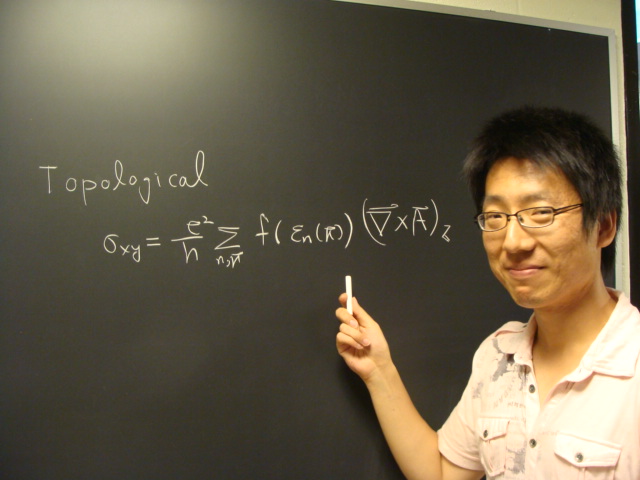
In the second half of the discussion, a robust definition of the topological insulator was given based on the spin Chern number assuming spin being conserved. The spin Chern number is always an integer and it is calculated by integrating the curl of a Berry phase term in k-space. This number can be calculated for each occupied state and the sum over all the occupied states gives the total spin Chern number which is proved to always be an integer. This number is even for a conventional band insulator and odd for a topological band insulator. A model calculation was done to show how one can derive the Chern number using the model Hamiltonian which preserves the time reversal symmetry. Time reversal symmetry was introduced as iSy.K where K is the complex conjugate operator. The calculation was done through a mapping from kx,ky space into theta,phi space using a Jacobian. The "topology" comes from the way we define this mapping.