Thursday, August 12, 2010

Nematicity in the Pseudogap Phase of the Cuprates


Journal club talk by Christoph M. Puetter on August 12, 2010

Reference:
M. Lawler et al., Nature 466, 347, (2010)
(http://www.nature.com/nature/journal/v466/n7304/full/nature09169.html)

Christoph chose this paper, written by the founder of this Journal Club, for an interesting discussion this week. There were broad discussions on the Cuprate phase diagram, nematicity and STM measurements. A lively debate ensued about the key finding of the paper that the nematic order tracks the pseudogap.

Thursday, August 5, 2010

Mechanics of energy transfer in light-harvesting antenna proteins: scale-dependent descriptions

Journal club talk by guest speaker Hoda-Hossein Nejad from the Department of Chemistry, UofT, on August 5, 2010

Abstract:
Recent observations of persistent coherence in light-harvesting
antenna proteins pose some interesting questions regarding the role of
quantum effects in photosynthesis: Has nature chosen quantum mechanics as
an strategy for survival? How important are the quantum effects, and on
what scale are these effects significant?

It is plausible to argue that a fully quantum treatment captures the
dynamics of energy transfer on the scale of a few chromophores, but is
both unnecessary and unrealistic for descriptions of long-range energy
transfer between multiple proteins. In this talk,, I will present two
different formulations of the exciton transport problem as applied to the
photosynthetic light-harvesting complex PE545: 1) A fully quantum
description on the scale of a single protein, which takes into account the
interference between pathways leading to a given site. 2) A mixed quantum
classical treatment on the scale of multiple proteins, in which energy
transfer is regarded as a stochastic hop between delocalized eigenstates.

Thursday, July 29, 2010

Inverse Spin Galvanic Effect in the Interface between a Topological Insulator and a Ferromagnet


Journal club talk by William Witczak-Krempa on July 29, 2010

References:
I. Garate, M. Franz, Phys. Rev. Lett. 104, 146802 (2010)
http://prl.aps.org/abstract/PRL/v104/i14/e146802
arXiv: http://arxiv.org/abs/0911.0106

William went over a recent PRL paper by I. Garate and M. Franz [1], in
which they explore the behaviour of a thin ferromagnetic layer coated on the surface of a 3d topological insulator. They suggest the
possibility of dissipationless current-induced magnetization reversal in the ferromagnet, which might have applications in the field of spintronics.

Thursday, July 22, 2010

All you wanted to know about photonic crystals but were afraid to ask


Journal club talk by Wah-Tung Lau on July 22, 2010

The slides can be found here.

References:
[1] S. John, Phys. Rev. Lett. 58 2486 (1987).
[2] S. John, "Localization of Light", Physics Today 44 32 (May 1991).
[3] S. Fan et. al., Phys. Rev. Lett. 78 3294 (1997).
[4] S. Johnson et. al., Optic Express 9 748 (2001).
[5] W. T. Lau et. al., Appl. Phys. Lett. 92 103106 (2008).
[6] Experiments: Prof. S. G. Johnson's slides at
http://ab-initio.mit.edu/photons/tutorial/L3-fab.pdf

Tuesday, July 20, 2010

Spin Liquid state of the S=1/2 Heisenberg model on the anisotropic triangular lattice


Journal Club talk by Dariush Heidarian on July 8, 2010
(click here for slides in pdf format)

Summary by Vijay Shankar Venkataraman

References:

Theoretical Papers:
1) D. Heidarian, S. Sorella, and F. Becca, Phys. Rev. B 80, 012404 (2009)
2) T. Pardini and R. R. P. Singh, Phys. Rev. B 77, 214433 (2008)
3) O. A. Starykh and L. Balents, Phys. Rev. Lett. 98, 077205 (2007)
4) S. Yunoki and S. Sorella, Phys. Rev. B 74, 014408 (2006)
5) Zheng Weihong, R. H. McKenzie, and R. P. Singh, Phys. Rev. B 59, 14367 (1999)
6) M. Bocquet, F. H. L. Essler, A. M. Tsvelik, and A. O. Gogolin, Phys. Rev. B 64, 094425 (2001).

Experimental Papers:
1) R. Coldea, D. A. Tennant, A. M. Tsvelik, and Z. Tylczynski, Phys. Rev. Lett. 86, 1335 (2001)
2) Y. Shimizu, K. Miyagawa, K. Kanoda, M. Maesato, and G. Saito, Phys. Rev. Lett. 91, 107001 (2003).

The existence of spin-liquids is still mired in controversy although there are various promising candidates. Prominent among these is a quasi-two-dimensional class of organic compounds comprised of dimers of an organic molecule. A single electron is localized on each dimer and the compound forms layers of triangular lattices.

Dariush began with a quick review of the experimental results of Shimizu et al where these materials show no sign of long range order down to very low temperatures. He then introduced the anisotropic Heisenberg model on the triangular lattice with nearest-neighbour interactions but with exchange anisotropy. This led to a vigorous discussion on the possible types (Ferromagnetic/Antiferromagnetic) and strengths of coupling constants that would cause frustration. After the audience reached a consensus, Dariush gave a brief survey of previous theoretical work on the model.

Dariush moved on to discussing his own work studying the Hamiltonian by using a variational wavefunction approach. After discussing different methods of doing a variational calculation, he showed us the different variational wavefunctions that he used in his work. Dariush then presented his results for the ground state energy and compared it with previous work.

Discussing results for the spin-spin correlation function as a function of anisotropy for different lattice sizes, he showed how the structure factor scales as a function of lattice size for different anisotropies. Dariush then showed us the phase diagram as a function of anisotropy which told us that the variational calculation points towards the existence of a stable spin-liquid state in the anisotropic triangular lattice.

Time had run out by this point and an excursion into the technicalities of the variational Monte Carlo calculation was reserved for another journal club meeting.

Thursday, July 15, 2010

Imaging the Fano lattice to hidden order transition in URu_2Si_2


Journal club talk by Fazel Fallah Tafti on July 15, 2010

Reference:
Nature, 465, 570

Thursday, June 17, 2010

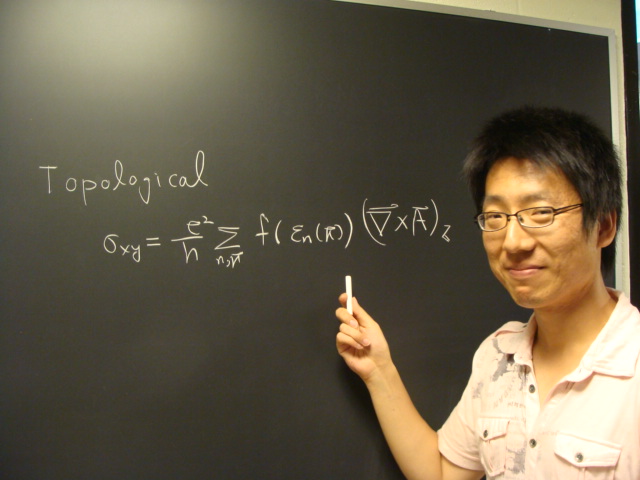
Quantum spin Hall effect: Dirac particle approach


Journal club talk by Bohm-Jung Yang on June 17, 2010
(Slides can be found here)

References:
(1) "The anomalous hall effect and magnetic monopoles in momentum
space", Z. Fang et al., Science, 302, 92 (2003)
(2) "Quantum spin hall effect and topological phase transition in HgTe
Quantum wells", B. Andrei Bernevig et al., Science, 314, 1757 (2006)
(3) "Topological quantization of the spin Hall effect in two-dimensional
paramagnetic semiconductors", X. -L. Qi et al, PRB, 74, 085308 (2006)
(4) "Topological insulators", M. Z. Hasan et al., Arxiv: 1002.3895